
If you know me, you know I am a smiley person. I am from the South, where smiling at strangers and making small talk are part of everyday life. You go to the grocery store, smile, and ask, “How are you today?” As you walk down the street, you pass strangers with a smile and a warm “hi.” It’s simply our norm.
So, when I did my pre-departure research on cultural norms in Prague, I was preparing myself for a summer of poker face. Or, as Gen Z would say – and here’s some Gen Z slang for you – a summer of Slavic mogging, which basically means serving model face with no smile. I quickly learned that Czechs generally view smiles from strangers as unusual. The thinking is simple: I don’t know you. Why are you smiling at me? Honestly, that’s fair. Smiles are reserved for genuine interactions. I can admit that, in the South, smiles don’t always reflect happiness; they’re often just an automatic response when making eye contact with someone.
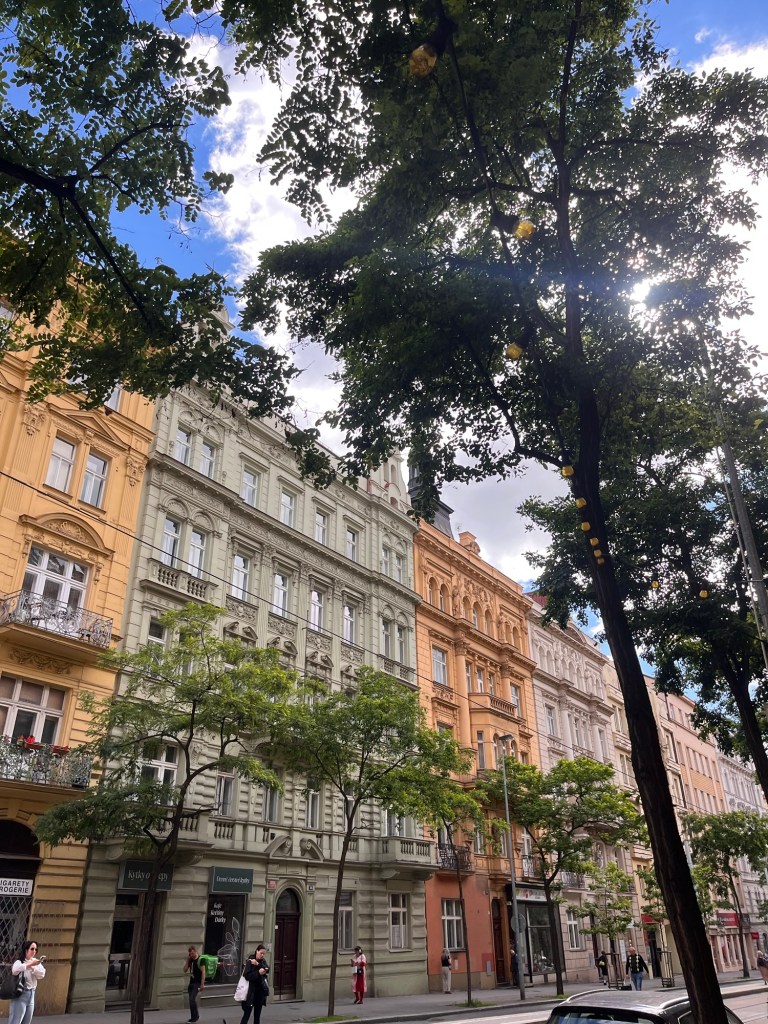
As my summer internship comes to an end, I’ve gotten pretty good at mastering the “I mind my business” look while passing strangers or ordering at cafés. However, I am me, and every now and then my smile slips out. Walking past Prague’s pastel-colored architecture every day makes it hard not to!
But as I have built relationships with my coworkers and other locals, I have come to understand that while Czechs may seem less outwardly warm to strangers, they deeply value trust and taking the time to get to know people. I remember when I began my internship, I greeted my coworkers with “Dobrý den,” which translates to a formal hello or “good day.” After about a week, I started hearing “Ahoj,” the informal greeting used with people you know well. It was a small change, but one that made me feel like I had earned my place beyond simply being “the American intern.”


Other cultural norms I have learned to navigate involve using public transit – which, by the way, is amazing here! Whether it is the tram, metro, or bus, Prague has you covered. Every day I take the metro to work, which is my personal favorite during the summer heat. Going below ground and feeling the breeze from a high-speed train is the perfect way to cool off. The two biggest adjustments I have made are learning escalator etiquette and keeping my volume down.
Whenever you step onto an escalator, the right side is for standing and the left side is for those in a hurry, otherwise known as the passing lane. If you stand on the left, you immediately give yourself away as a tourist. You will probably be asked to move – and not with the sugary tone of a Southerner.
Once you are on the metro, another unwritten rule takes over: keep your voice down. For us talkative Americans, this can be a challenging adjustment. If you are unknowingly airing out your conversation to the entire train car, you will probably earn a few judgmental looks or even be asked to quiet down. Surprisingly, I have grown to love this rule because it makes commuting feel calmer and more respectful.
When living abroad, you don’t realize how “on” your brain needs to be. Mundane tasks like locking doors, plugging in your charger, or using unfamiliar appliances require extra thought. It is completely normal to feel more exhausted at first because your brain is constantly adapting.
I have learned that living like a local does not mean abandoning who I am. Instead, it has meant paying attention to the unwritten rules, observing before assuming, and learning from my mistakes. That, to me, is the process of adapting. It does not mean I have to stop smiling or making small talk with baristas – I still genuinely want to know what pastry or drink they recommend!
I think that is the beauty of interning abroad: challenging yourself not only to succeed in a new work environment but also to adapt to a new culture so you can build meaningful cross-cultural relationships. This means recognizing that there are no “right” or “wrong” cultural norms – just different ones.
The concept of authenticity has followed me into my internship. In PR, building trust – whether with clients, audiences, or brands – begins with authenticity. Seeing how authenticity looks different, yet similar at times, has been a pleasantly unexpected lesson of my summer.
For instance, in the Czech workplace, feedback is not sugar-coated but objective and direct. In the South, we tend to cushion criticism with compliments because we worry about coming across as mean. This internship has helped me better understand constructive feedback. I have even learned that sometimes no feedback is actually a good sign – it often means you are doing things well. I am much more accustomed to receiving frequent feedback, which I truly value, so that adjustment took some getting used to.
While authenticity has shaped my experience professionally, I have also seen it in everyday moments.
The other night, I went out to sing karaoke with my friends. If you know me, you know I LOVE karaoke. As the night was winding down, we still had two songs in the queue. The DJ had just reset the queue because there were so many requests waiting. Since we needed to leave, I couldn’t bring myself to walk out without letting him know that we wanted to remove our songs so we wouldn’t delay everyone else’s chance to sing.
The DJ thanked me for being considerate and told me that the next time we came in, I should let him know because he would move our songs up in the queue. While this moment certainly speaks to the universal value of consideration, it also reminded me that adapting to another culture does not mean changing your values. I know what it feels like to eagerly wait for your song to come up, and I would have felt terrible knowing that our no-show songs were holding everyone else up.


Overall, this experience has allowed me to live like a local while still learning like a tourist. I have learned that adapting to another culture does not require losing yourself. Instead, it asks you to become more observant, more open-minded, and more intentional. I will always be the smiley Southern girl who asks baristas for their favorite drink order, but now I also know which side of the escalator to stand on, when to keep my voice down on the metro, and how to appreciate the different ways authenticity is expressed across cultures. Those are lessons I will carry with me long after I leave Prague.
Ahoj Friends!


Leave a Reply